The hammock ripped right down the middle, and I landed on a bamboo floor with my breakfast banana still in my hand.
My friend Jess didn't even flinch. She just passed me a new banana from the pile and said, “That’s the second one this week. Maybe stop swinging so hard.”
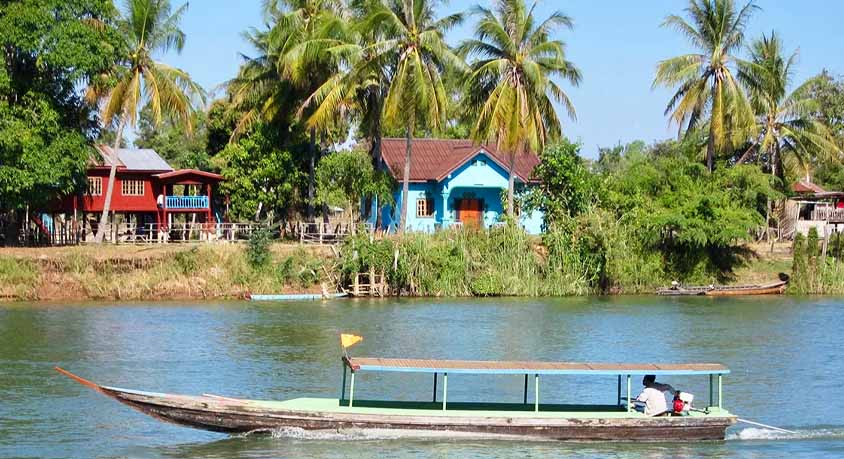
We were on Don Det, the smallest and cheapest of the thousands of islands in southern Laos’s Si Phan Don archipelago. Two minutes earlier, I’d been bragging about how I’d paid 60,000 kip ($3.50) for a bungalow with a river view. The hammock was a bonus. A bonus that failed.
But that’s the trade-off you make when you skip the Luang Prabang tourist machine.
Getting here was half the comedy. We took a sleeper bus from Vientiane to Pakse – 220,000 kip ($10) for a “VIP” bed that was exactly two inches longer than my 170cm frame. My feet hung off the end. The man next to me snored like a chainsaw starting.
From Pakse, we paid 50,000 kip for a minivan to Nakasang village. The driver stopped three times for no apparent reason. Once to buy cigarettes. Once to let a chicken cross the road. Once because he felt like it.
At Nakasang, the local boat to Don Det costs 20,000 kip. Same boat. Same route. A French tourist at the dock told us she’d booked a “private transfer” online for 150,000. She looked at our tickets, looked at hers, and said a word I won’t repeat here.
Don Det and its neighboring island Don Khon are connected by an old French railway bridge – a rusty metal skeleton from the colonial era that feels like it might collapse if you sneeze too hard. Crossing it costs nothing. The view of the Mekong splitting into a thousand channels is worth every broken hammock.
The famous thing here is the Irrawaddy dolphins. Yes, freshwater dolphins. They live in a deep pool near the Cambodian border, and every tour in town charges 150,000 kip for a “dolphin watching boat with guide.”
We rented two bicycles for 20,000 kip each – full day, no deposit, the tires held air mostly – and rode to the southern tip of Don Khon. At the viewpoint near the old customs house, we sat on a rock and watched for an hour. A local fisherman paddled by and pointed to a spot fifty meters from our rock.
Three dolphins surfaced. Then four. Then a baby one. No boat engine noise. No guide yelling “look left.” Just us, the river, and animals that didn’t know they were supposed to be a tourist attraction.
The fisherman wanted nothing. We gave him 30,000 kip anyway. He smiled and gave us a grilled fish wrapped in banana leaf. Best trade of the trip.
The Li Phi Falls (also called Tat Somphamit) on Don Khon is where the Mekong drops over a series of basalt ledges. The entrance fee is 55,000 kip. Most tourists pay it, walk to the main viewing platform, take a photo, and leave.
We paid. Then we walked downstream along the rocks – carefully, because wet basalt is slippery like ice – to a pool where the current swirls into a natural jacuzzi. A group of Lao teenagers were already there, taking turns jumping off a three-meter rock into the foam.
One of them, a guy named Tu, saw me hesitating. “You scared?” he yelled in perfect English. I said yes. He said, “Me too for the first time. Now I do it ten times.” I did it once. My stomach stayed somewhere above the rock for about two seconds. Then I hit the water and everything hurt. Worth it.
No lifeguard. No waiver to sign. Just consequences and fun, mixed together.
The food game on Don Det is a trap if you eat on the main strip. The restaurants there sell “happy pizzas” (weed-infused, if you’re into that) for 80k and “Lao barbecue” for 120k. The quality matches the price – meaning low.
Walk five minutes inland to the local market near the school. A woman named Mam makes Lao sausage from scratch every morning. Sticky rice, herbs, pork, and more black pepper than you think you can handle. She sells it wrapped in banana leaf for 15,000 kip per roll. We bought four.
She also sells fried crickets for 5,000 a bag. Jess ate one. She said it tasted like a crunchy raisin with legs. I took her word for it.
Breakfast is the easiest win. The French baguette obsession from colonial days is still alive. A roadside cart near the Don Det pier sells sandwiches with pâté, cucumber, chili sauce, and a mystery green herb for 10,000 kip. That’s forty cents. I ate three in one morning and felt no shame.
The quietest spot on both islands is the old French port at Ban Khone village on Don Khon. A few crumbling colonial buildings, an abandoned customs house, and a pier where no boats come anymore. We sat there at sunset watching the sky turn pink and purple over Cambodia across the river.
An old man walked by pulling a cart of firewood. He stopped, looked at the same sunset, and said something in Lao. I understood nothing. But his hand gestured like he was painting the sky. Then he nodded and kept walking.
That sunset cost zero kip. That memory will cost me nothing to keep either.
Timing your visit here is actually important. December to February is cool and dry, which sounds perfect except every backpacker in Southeast Asia has the same idea. The bungalows fill up. The hammocks break faster. March to May is hot – like 38 degrees and no shade hot – but the waterfalls are low, which means swimming pools are safer, and you’ll have entire beaches to yourself.
We went in early March. It was hot enough that my sunglasses fogged up every time I stepped outside. But we found a bungalow for 50,000 kip a night because nobody else wanted to sweat through their sleep. I’ll take sweat over crowds any day.
Avoid Don Det entirely if you hate backpackers who play reggae on portable speakers. The island has that reputation for a reason. We found a homestay on the quieter side of Don Khon instead – 70,000 kip per night, a real mattress, and a shared bathroom with a frog that lived in the drain. I named him Gerald. He paid no rent.
The four days we spent on these islands cost us 1,150,000 kip each. That’s about sixty-five US dollars. That includes transport from Vientiane, all food, accommodation, bikes, the waterfall entrance, and two replacements for the ripped hammock (the second one also broke, but that’s a different story).
Jess and I sat on the pier on our last morning, watching the sunrise boats cross to Cambodia. She looked at the receipt from our homestay – handwritten, stained with fish sauce – and said, “A hotel breakfast in Bangkok costs more than our entire stay here.”
I thought about the ripped hammock, the frog named Gerald, and the dolphin that surfaced just as I was about to give up looking.
Then the third replacement hammock broke behind us. We didn't even turn around. Just laughed and slung our backpacks on. The Mekong doesn't care about your gear. It just flows. And sometimes, if you're lucky, it shows you something you can't buy.